

Connecting Carbon Markets: A guide to the Core Carbon Principles
MODULE 2: Executive Summary
High-Integrity Carbon Markets: a guide for policymakers
A practical guide to help policymakers develop high-integrity carbon market frameworks, using the Core Carbon Principles (CCPs) as a global threshold for carbon-credit integrity.
Carbon markets can support governments to mobilise climate finance, reduce emissions and advance national climate and development objectives. But achieving these benefits depends on strong governance, clear policy choices and confidence in the integrity of carbon credits.
This executive guide from the upcoming second module of Connecting Carbon Markets: A Guide to the Core Carbon Principles provides policymakers with a practical pathway for developing high-integrity carbon market frameworks. It shows how governments can use the CCPs as a common integrity threshold while tailoring their approach to national priorities, institutional capacity and different uses of carbon credits.
Get updates on future CCP Guide Modules:
CCP Guide Interest
A data capture form for the CCP guide pages, for those who are interested in future updates.
A practical pathway for policymakers
The Core Carbon Principles establish a global threshold for high-integrity carbon credits, providing a common foundation for credit integrity across different buyers and uses.
Policymakers can draw on the CCPs when developing carbon market frameworks, including requirements for credits purchased by corporate buyers, used in emissions trading systems and carbon tax schemes, or transferred under Article 6 of the Paris Agreement.
Government-administered crediting programs can also seek assessment against the CCPs. This common threshold can support greater consistency and interoperability across carbon markets, while governments retain responsibility for determining the additional eligibility, authorisation and accounting requirements appropriate to their national climate objectives.
What you will learn
This module will help policymakers understand how to:
From objectives to implementation: a seven-step Decision Map
At the centre of the guide is a seven-step Decision Map designed to help governments move from policy objectives to practical implementation.
The steps are flexible. Governments can pursue more than one pathway, and some steps can take place in parallel. Throughout the process, the CCPs provide a common threshold for carbon-credit integrity while leaving governments able to establish additional requirements reflecting national circumstances and policy goals.
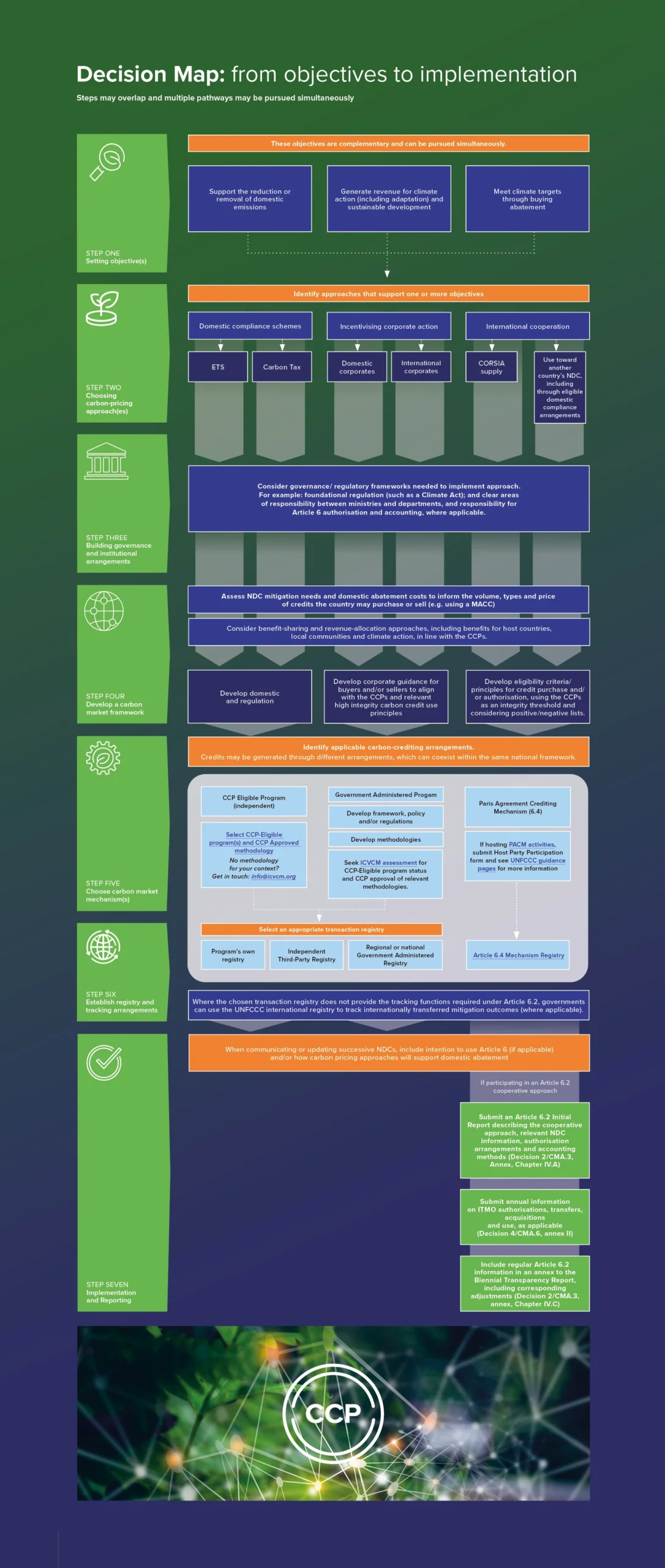
Define what the government wants to achieve through carbon markets, from supporting domestic emissions reductions and mobilising climate finance to generating economic and community benefits or purchasing mitigation outcomes.
Consider the approaches best suited to those objectives, including domestic emissions trading systems or carbon taxes, policies supporting corporate demand, and international cooperation under Article 6 or CORSIA.
Establish clear responsibilities for policy, regulatory oversight, credit eligibility, project authorisation, registries and NDC accounting, where relevant.
Put in place policies, rules and safeguards governing participation, covering areas such as credit eligibility, environmental and social safeguards, benefit sharing and protection of national climate objectives.
Determine which mechanisms can issue credits for different buyers and uses, including independent crediting programs, government-administered programs and the Paris Agreement Crediting Mechanism.
Ensure carbon credits can be uniquely identified, issued, tracked, transferred and retired or cancelled transparently, with the necessary protections against double issuance and double use.
Establish appropriate monitoring, reporting and review arrangements, including additional authorisation, accounting and reporting requirements where countries participate in Article 6.
Who this guide is for
This guide is designed for a wide range of stakeholders working in or engaging with carbon markets.
Governments and policymakers
Develop or strengthen carbon market policies using a practical framework grounded in high integrity.
Ministries and public authorities
Understand the institutional, regulatory, registry and reporting arrangements involved in implementing carbon markets.
Carbon market practitioners and advisers
Explore how the CCPs can be incorporated into national frameworks and different uses of carbon credits.
International and development partners
Identify where technical assistance, capacity building and international cooperation can support countries as they develop their carbon markets.
About the Integrity Council
The Integrity Council for the Voluntary Carbon Market (the Integrity Council) sets a global threshold standard for high-integrity carbon credits through the Core Carbon Principles.
It assesses carbon-crediting programs and methodologies against this threshold to support transparency, consistency and confidence across carbon markets.

Download the CCP Guide Executive Summary
Explore the seven-step pathway for developing carbon market frameworks grounded in the Core Carbon Principles.
Get updates on future CCP Guide Modules:
CCP Guide Interest
A data capture form for the CCP guide pages, for those who are interested in future updates.